Comparison of the approaches#
Author: Jørgen S. Dokken
SPDX-License-Identifier: MIT
We run the three representations of a space with a cell-wise degree on the same problem:
A hierarchical basis, restricted algebraically with sub-matrices.
Restricted dofmaps of one space per degree on the whole mesh.
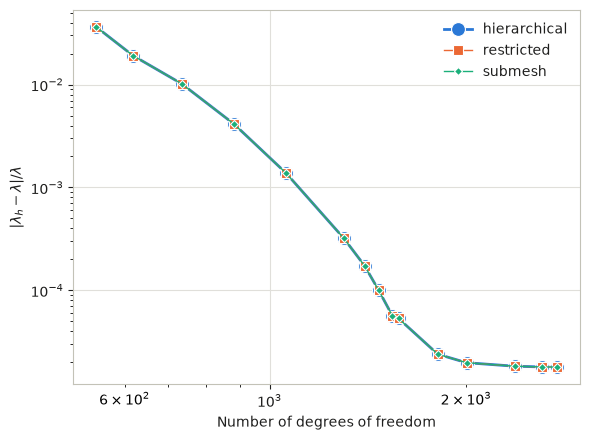
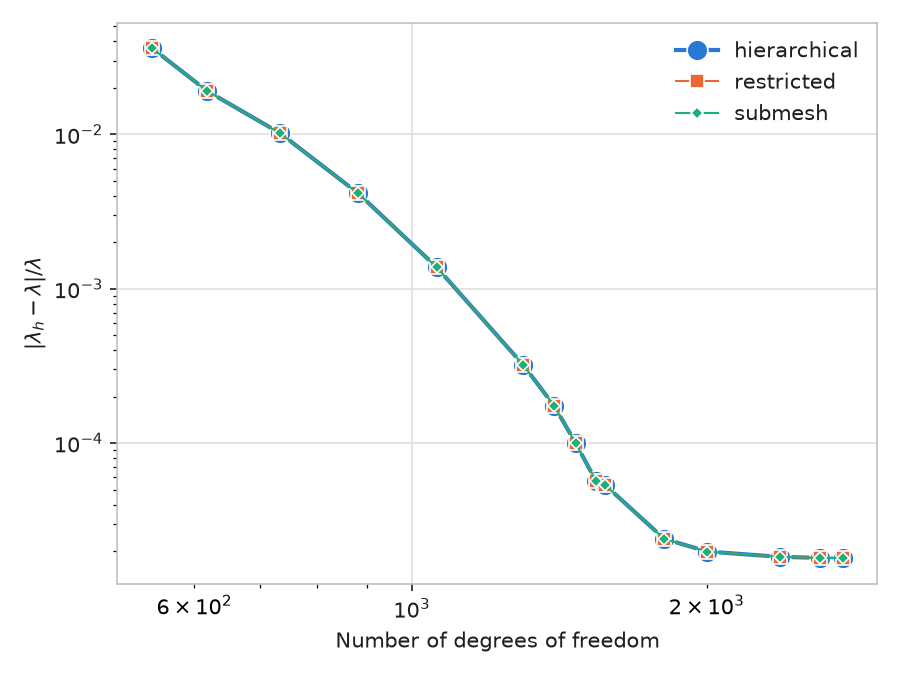
With the same penalty parameter, all three give the same discrete problem, so the eigenvalues agree at every iteration up to the quadrature: the hierarchical approach integrates every cell with the quadrature of the maximal degree. We use the penalty \(\sigma = \alpha p_{max}^2\) on every facet, so that the hierarchical approach only assembles its matrices once.
from mpi4py import MPI

from dolfinx_padapt import EigenvalueProblem, create_pacman
from dolfinx_padapt.adaptivity import solve_adaptive
from dolfinx_padapt.approaches import APPROACHES
from dolfinx_padapt.forms import Parameters
from dolfinx_padapt.plotting import plot_convergence
from dolfinx_padapt.postprocessing import print_summary

mesh = create_pacman(MPI.COMM_WORLD, h=0.3, h_corner=0.01)
params = Parameters(pmin=1, pmax=6, penalty="global")

histories = {}
for name, Approach in APPROACHES.items():
    approach = Approach(EigenvalueProblem(mesh), params)
    histories[name] = solve_adaptive(approach, max_iterations=15)
The summary shows the number of iterations, the final number of degrees of freedom and error, and the largest relative difference of the eigenvalue to the first approach over all iterations. The problem is too small for the timings to be meaningful, so we do not compare them.
print_summary(histories)
     approach  its     dofs      error max rel. diff
 hierarchical   15     2755  1.799e-05      0.00e+00
   restricted   15     2755  1.799e-05      2.41e-06
      submesh   15     2755  1.799e-05      2.41e-06
All approaches follow the same convergence history:
if mesh.comm.rank == 0:
    plot_convergence(
        histories, "comparison_convergence.png", ylabel=r"$|\lambda_h - \lambda| / \lambda$"
    )
Which approach to use#
Submeshes use the mixed-domain assembly of DOLFINx: the integrals over the interfaces are taken over the parent mesh and couple the submeshes through their entity maps. They support both discontinuous and continuous spaces with the same code, and the number of degrees of freedom and the quadrature follow the degree of each cell.
Restricted dofmaps give the same results, but rely on hand made dofmaps whose rows outside the restriction are not valid, need the neighbour trick for the kernels on the interfaces, and keep the full dofmap of every degree on the whole mesh.
A hierarchical basis only assembles its matrices once with a fixed penalty, but is limited to discontinuous spaces and scalar problems, stores the operator of the maximal degree on the whole mesh, and integrates every cell with the quadrature of the maximal degree.
We recommend the submesh approach.